
Planning a tennis court involves far more than selecting a surface and marking lines. Zoning rules, permitting requirements, safety clearances, and design standards all influence how a court can be built and used. Early decisions affect long-term usability, compliance, and overall investment value. In this blog, we outline key planning considerations and regulatory factors to help ensure a smooth, well-informed court development process.
Key Takeaways
- Any new tennis court, whether for a home, school, or club, must meet ITF and USTA dimensional requirements plus local zoning, building code, and accessibility regulations before construction begins.
- Planning timelines typically run 3–9 months for permits, design, and contractor scheduling, so start the approval process well before your target completion date.
- Standard overall court dimensions require approximately 120 ft x 60 ft for recreational courts, with larger envelopes needed for tournament facilities under ITF and USTA guidance.
- Effective planning addresses court orientation (typically north–south), the court’s foundation, drainage systems, surface selection, lighting, and fencing, all of which must meet published standards.
Why Planning and Regulations Matter for Tennis Courts
A tennis court is far more than a paved rectangle with painted lines. It’s a regulated sports facility governed by international standards, national guidelines, and local ordinances that dictate everything from the playing area dimensions to fence heights and lighting curfews. Planning errors discovered after construction begins are expensive to correct, sometimes requiring complete demolition and rebuilding of non-compliant elements.
The depth of planning and regulatory compliance varies significantly based on your court’s intended use. A residential court for family practice faces different requirements than a school facility, municipal park installation, or ITF-certified tournament venue. Each category triggers specific expectations around tennis court dimensions, spectator accommodations, accessibility features, and safety clearances.
Defining Project Scope and Court Purpose
Before sketching layouts or contacting contractors, the first planning decision involves defining your court’s purpose. A court designed for private practice operates under different constraints than one intended for USTA-sanctioned events or school athletic programs.
Typical Use Cases and Regulatory Expectations
| Court Type | Typical Requirements | Regulatory Intensity |
| Home/Residential Courts | Basic zoning compliance, setbacks, and possible lighting restrictions | Lower |
| School Courts | Full ITF dimensions, accessibility compliance, safety fencing | Moderate |
| Municipal/Public Courts | ADA compliance, lighting controls, stormwater management | Moderate to High |
| Tennis Club Facilities | USTA guidelines, spectator seating, and parking requirements | High |
| ITF-Certified Tournament Venue | Full ITF specifications, expanded clearances, broadcast considerations | Highest |
Professional and recreational courts share the same playing area dimensions, 78 feet long by 27 feet wide for singles and 36 feet for doubles play, but differ substantially in safety clearances, spectator provisions, and amenity requirements. Competitive play at sanctioned events demands strict adherence to court markings, net heights, and surface performance standards that recreational courts may approach more flexibly.
Private home courts offer the most flexibility, though they still face zoning laws and safety requirements. School and municipal facilities must demonstrate accessibility compliance and often undergo more rigorous plan review.
Creating Your Project Brief
Before engaging designers or contractors, develop a written project brief that captures:
- Number of courts and configuration (single court vs. multi-court facilities)
- Indoor and outdoor courts preference or requirements
- Budget range for construction and five-year maintenance
- Target completion date and seasonal constraints
- Primary use case (family recreation, club programming, competitive play)
- Special features (lighting, seating, shade structures, storage)
This document becomes your reference point throughout planning and helps contractors provide accurate estimates.
Regulatory Framework: Who Sets the Rules?
Tennis court construction operates under overlapping jurisdictions. Sports federations establish playing standards, national bodies adapt those rules to local conditions, and municipal authorities control land use and construction permits. Compliance with all layers is necessary for a fully functional, legally sound facility.
International and National Sports Bodies
The International Tennis Federation serves as the global authority on court dimensions, court markings, tennis net specifications, and surface performance categories, forming the foundation for tennis court construction and design standards used worldwide. The ITF Rules of Tennis define the standard tennis court layout used worldwide, while the ITF Court Pace Classification Programme categorizes surfaces from slow to fast based on ball behavior.
Construction and Safety Standards
In the United States, the American Sports Builders Association provides exhaustive construction guidelines covering:
- Site investigations and earthwork
- Subbase preparation and drainage systems
- Reinforced and post-tensioned concrete specifications
- Acrylic resurfacing systems
- Fencing, lighting, and maintenance protocols
ASTM International standards address surface friction, fencing durability, and safety performance.
Local Authority Requirements
Regardless of federation guidelines, planning permission, zoning approval, building permits, and environmental sign-offs come from local authorities, city planning departments, county boards, or regional councils. These bodies enforce:
- Zoning laws dictate where courts may be built
- Setback distances from property lines
- Maximum fence and light pole heights
- Stormwater management requirements
- Operating hour restrictions
Always verify current local rules before finalizing design, as requirements vary significantly between jurisdictions and change periodically.
Zoning, Land Use, and Neighborhood Constraints
Zoning categories determine whether tennis courts are permitted on your property. Residential zones may allow courts as accessory structures, while commercial or agricultural zones might require special use permits or variances.
Key zoning considerations include:
- Setback requirements: Most residential jurisdictions require a setback between courts and property lines
- Height limits: Fencing and light poles face maximum height restrictions, often 10–10 feet for fencing and 20–30 feet for lighting
- Impervious surface limits: Tennis courts add significant paved area that may trigger stormwater detention requirements
- Noise regulations: Ball impacts and player voices can generate complaints, particularly for courts near bedrooms
Many outdoor courts face lighting restrictions, including curfews (lights off by 10:00 PM) and maximum illuminance levels at property boundaries. Discussing your project with neighbors before formal applications can reduce objections at planning board hearings.
Building Permits, Codes, and Structural Regulations
Jurisdictions may require permits for:
- Asphalt / Concrete slabs
- Permanent fencing installations
- Electrical work for lighting systems
- Any structures with footings (shade canopies, storage buildings)
Typical permit submissions include:
- Scaled site plans showing court location, setbacks, and orientation
- Drainage plans demonstrating stormwater management
- Construction drawings with slab thickness specifications
- Fence layout and structural details
- Electrical plans for lighting with photometric studies
Light poles and tall fencing must be engineered to local wind and seismic codes, ASCE 7 in the United States or Eurocode in Europe.
Timeline expectations: Obtaining permits will be dependent on the local jurisdiction and may vary greatly.
Accessibility and Inclusive Design Regulations
Public courts and school facilities must comply with accessibility regulations:
- United States: Americans with Disabilities Act (ADA)
- United Kingdom: Equality Act and Approved Document M
- European Union: National accessibility directives
Private residential courts are typically exempt but may benefit from inclusive design features.
Typical accessibility requirements include:
- Step-free routes from parking to courts with compliant ramp slopes (maximum 1:12 grade)
- Minimum 36–48 inch clear widths for gates and pathways
- Accessible spectator seating areas with companion spaces
- Accessible restrooms when facilities serve public events
- Clear, high-contrast signage
Wheelchair tennis uses standard court dimensions but benefits from smoother baseline transitions and adequate maneuvering space around the court perimeter.
Funding grants from organizations like the USTA Facility Assistance programs often require documented accessibility provisions and inclusive programming commitments.
Tennis Court Dimensions, Layout, and Safety Clearances
Accurate dimensions and safety run-off areas represent core regulatory requirements, not optional design preferences. Undersized clearances compromise player safety and disqualify courts from sanctioned competition.
Standard Playing Dimensions
ITF-compliant tennis court design specifies:
| Element | Measurement (Imperial) | Measurement (Metric) |
| Court Length | 78 ft | 23.77 m |
| Singles Court Width | 27 ft | 8.23 m |
| Doubles Court Width | 36 ft | 10.97 m |
| Service Line from Net | 21 ft | 6.40 m |
| Service Box Width | 13.5 ft | 4.115 m |
These dimensions define the playing area within the court lines. The total facility footprint must include substantial clearances beyond these boundaries.
Read More: Dimensions of Tennis Courts
Safety Overrun Requirements
The space around the court protects players from collision with fences and allows full follow-through on shots:
| Facility Level | Baseline Runback | Sideline Clearance | Total Length | Total Width |
| Recreational Courts | 18–21 ft | 9–12 ft | 115–120 ft | 54–60 ft |
| Club/Scholastic | 21 ft | 12 ft | 120 ft | 60 ft |
| Professional Courts | 27 ft | 15 ft | 132 ft | 66 ft |
Multi-court facilities require additional cross-aisles and separation distances, typically 12 feet between adjacent courts, for safe player passage and official movement.
Court Markings, Line Widths, and Color Regulations
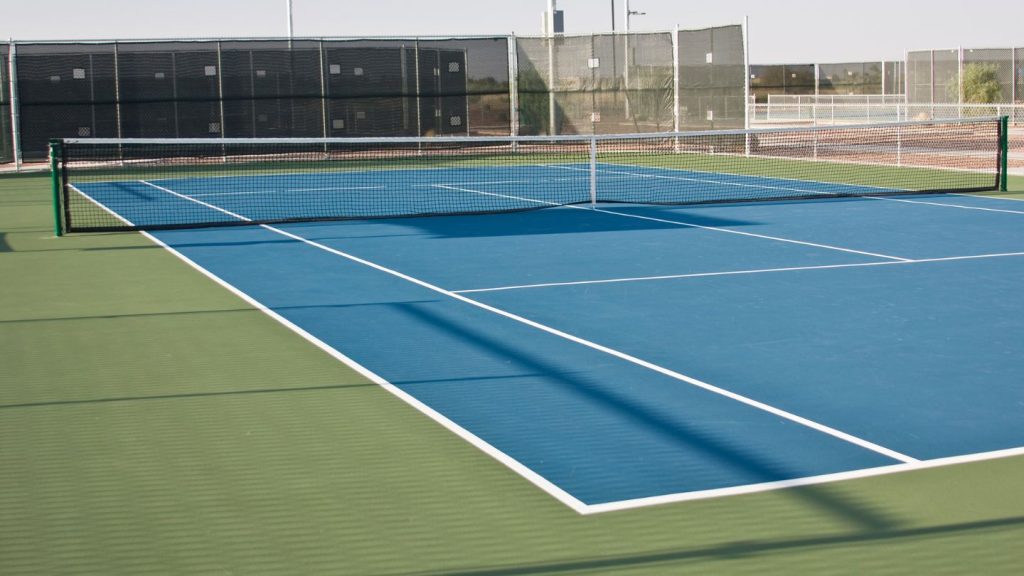
The ITF Rules of Tennis specify precise line standards:
- Baselines: Up to 4 inches (10 cm) wide
- Other lines (singles sidelines, service line, center service line, center mark): 2 inches (5 cm) wide
- Color: Must contrast sharply with court surface; white is standard for competition
Service boxes, defined by the service line and center service line, must be precisely marked for official play. Line paints should be permanent, non-slip, and UV-stable to withstand resurfacing cycles (typically every 4–8 years on hard courts).
Alternative court markings for youth tennis programs (red, orange, and green ball courts) follow specific guidelines and should not obscure standard adult court lines.
Read More: Understanding What Do Tennis Court Lines Mean: A Simple Guide
Orientation, Wind, and Sun Considerations
Proper orientation protects players and spectators from direct sun glare:
- Primary recommendation: North–south orientation minimizes direct sun in players’ eyes during morning and late-afternoon play
- Higher latitudes: Minor deviations (NNE–SSW) may be appropriate based on local sun path analysis
- Wind protection: Evaluate prevailing wind directions using meteorological data; wind barriers or landscaping may be necessary
Buildings and trees can cast shadows, affecting play and promoting mildew growth.
Planning the Court Structure: Foundation, Drainage, and Surface
Foundation, drainage, and surface type are interconnected decisions affecting regulatory compliance, playability, and long-term maintenance costs. Poor choices in any element compromise the others.
Before finalizing designs, commission a geotechnical report or basic soil investigation to determine bearing capacity, frost depth, and drainage characteristics. This investment prevents costly surprises during construction and ensures the court’s structure meets local building code requirements.
Climate data, freeze-thaw cycles, annual rainfall, temperature extremes, strongly influence slab thickness, sub-base depth, and drainage methods. Surface selection affects permitted runoff volumes, water usage, and potentially noise levels in dense residential areas, making long-term performance closely tied to tennis court maintenance and resurfacing considerations established during early planning.
Foundation and Sub-Base Design Requirements
The court’s foundation must provide a stable, properly drained platform for decades of play. Standard practice for hard courts includes:
- Subgrade: Compacted native soil, tested for adequate bearing capacity
- Base course: Crushed stone aggregate, typically 4–8 inches deep
- Surface slab: Reinforced concrete or asphalt, commonly 2–4 inches thick
Post-tensioned concrete slabs are increasingly specified in North America for superior crack control, particularly in expansive clay soils or freeze-thaw climates. These systems use tensioned steel cables within the slab to resist cracking forces.
Cold-climate construction requires frost-protected foundations with slab edges extended or insulated to local frost depth. Compaction testing during construction ensures the subgrade and base meet specifications.
Courts require a gentle surface slope, approximately 1% (1:100), for proper slope drainage without noticeably affecting ball bounce. Slope direction runs either lengthwise or across the court as approved by design guidelines.
Drainage, Water Management, and Environmental Compliance
Many municipalities regulate impervious surface coverage and stormwater runoff. A tennis court’s 7,000+ square feet of hard surface can trigger detention or infiltration requirements.
Effective drainage systems typically include:
- Surface swales and channels directing water away from the playing area
- Perimeter French drains collecting and conveying runoff
- Under-drain systems beneath porous bases for clay courts
- Connection to on-site stormwater management (retention tanks, bio-swales)
Clay courts and grass courts have additional irrigation needs that may face regulation in drought-prone regions, including watering restrictions or requirements for smart controllers with rain sensors.
Environmental compliance extends to erosion control during construction and restrictions on cleaning and weed control. Projects near wetlands, rivers, or protected watersheds require early coordination with environmental authorities.
Selecting and Specifying the Court Surface
Court surface selection balances playing characteristics, climate suitability, maintenance requirements, and regulatory approval:
| Surface Type | Ball Speed | Maintenance Level | Climate Suitability | Typical Lifespan |
| Hard Courts (Acrylic) | Medium-fast | Low maintenance | Most climates | 4–8 years to resurface |
| Clay Courts | Slow ball bounce | High (daily care) | Moderate climates | Continuous renewal |
| Grass Courts | Fast, low bounce | Very high | Temperate, humid | Seasonal |
| Synthetic Turf | Variable | Low | Most climates | 8–15 years |
| Synthetic Courts (Cushioned) | Medium | Low | Most climates | 10–15 years |
For tournament or sanctioned competitive play, surfaces should appear on the ITF Court Pace Classification list with appropriate category designation. Synthetic grass and artificial grass systems offer durability with reduced water requirements, unlike natural grass, which demands mowing, irrigation, and seasonal renovation.
Environmental certifications for recycled infill materials, and permeable systems can help secure planning approval and green-building credits. Specify manufacturer systems with documented performance data, warranties (5–8 years for acrylic surfaces, longer for quality synthetic turf), and installation by certified contractors.
Fencing, Lighting, and Ancillary Structures Within Regulations
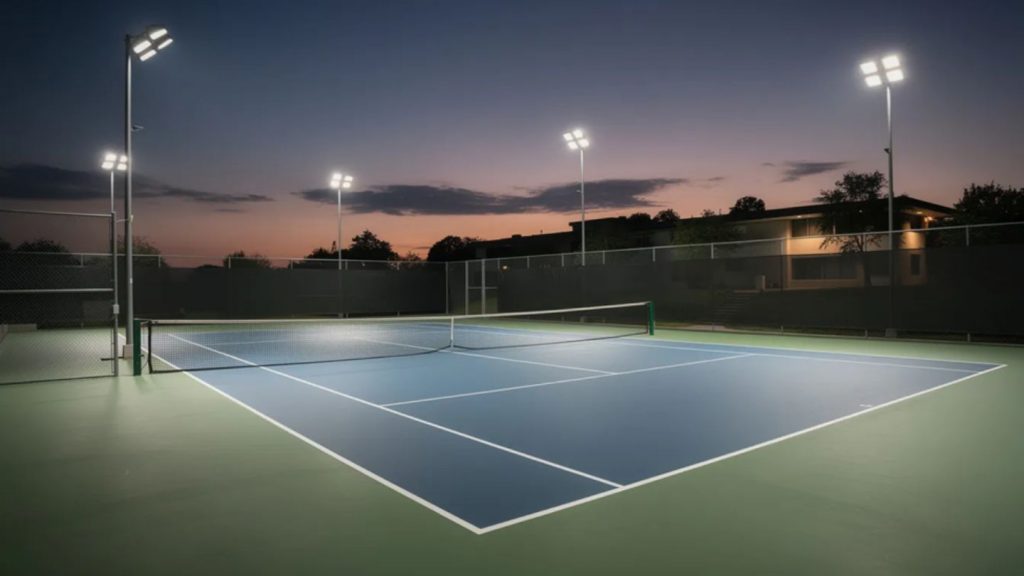
Fencing and lighting receive intense scrutiny from planning departments and neighbors. These elements often determine whether projects gain approval or face objections. Proper early design prevents costly redesigns and disputes.
Perimeter Fencing and Ball Containment
Standard competitive-level fencing specifications:
- Height behind baselines: 10–12 feet
- Height along sidelines: 4–10 feet
- Mesh size: 1.75–2 inch chain link
- Coating: Galvanized or vinyl-coated for durability
Some local rules or homeowner associations impose lower maximum heights, potentially requiring ball-stop netting set back from property lines. School environments may need anti-climb specifications to prevent finger entrapment.
Gates should be at least 3–4 feet wide to meet accessibility requirements, swing outward for emergency egress, and comply with fire and safety codes.
Wind barriers and windscreen installation increase wind loads on fencing substantially. Structural design must account for this with stronger posts and deeper footings to maintain the court’s integrity through severe weather conditions.
Read More: Ultimate Guide to Court Fencing and Netting Solutions
Lighting Design Standards and Light Pollution Controls
Lighting enables evening play but triggers significant regulatory review:
| Play Level | Target Illuminance | Typical Configuration |
| Recreational | 30 foot-candles (≈300 lux) | 6 light poles, 3 per side |
| Club/Collegiate | 50 foot-candles (≈500 lux) | 8 poles, higher wattage |
| Professional Tournaments | 75–100+ foot-candles | Enhanced systems |
Standard single-court layouts use six light poles with mounting heights typically 20–30 feet, depending on setting and local codes. Residential areas often restrict pole heights to reduce visual appeal concerns for neighbors.
Light spill controls commonly required:
- Full cut-off LED fixtures preventing upward light escape
- Aiming angles avoiding direct light into neighboring windows
- Maximum illuminance at property boundaries (often < 0.5 foot-candles)
- Timer controls or automatic shutoff (typically by 10:00 PM)
Permit submissions for lighted courts should include photometric studies demonstrating compliance with dark-sky or light-pollution ordinances. LED lighting systems reduce energy consumption by 60–70% compared to older metal halide technology.
Auxiliary Structures: Seating, Shade, and Support Facilities
Ancillary elements enhance the experience for players and spectators but add regulatory complexity, especially when integrating seating, shade, and storage that align with tennis court accessories and equipment requirements:
- Spectator seating: Permanent stands may require structural calculations and change project classification
- Covered benches and shade structures: Must withstand local wind and snow loads; fabric may require fire-rating compliance
- Umpire chairs: Typically not regulated unless permanently installed
- Storage sheds: Setback and height restrictions apply
- Restrooms and clubhouses: Trigger plumbing codes and fire separation requirements
All spectator areas require accessible viewing positions and accessible routes complying with ADA or equivalent regulations.
Process, Documentation, and Approvals: From Concept to Green Light
A successful tennis court project follows a clear sequence from initial concept through final sign-off. Documentation requirements increase substantially for multi-court facilities or publicly funded projects compared with single residential courts.
Typical Planning Stages
- Concept development: Define scope, budget, and timeline
- Feasibility assessment: Site investigation, preliminary cost estimates, regulatory review
- Preliminary design: Layout options, surface selection, amenity planning
- Permit applications: Submit plans to the planning and building departments
- Tendering: Obtain contractor bids based on approved designs
- Construction oversight: Inspections, quality control, change management
- Final certification: Occupancy approval, federation certification if applicable
Working with design professionals early ensures consistent plans and complete regulatory submissions, supporting long-term performance expectations such as maintaining your tennis court after construction. Integration with seasonal constraints is essential; asphalt and acrylic surfacing require specific temperature ranges, typically limiting work to April–October in northern climates.
Feasibility Studies, Surveys, and Impact Assessments
Pre-design work establishes project viability:
- Topographic survey: Elevation data for grading and drainage design
- Boundary verification: Confirms property lines for setback compliance
- Soil testing: Determines bearing capacity and drainage characteristics
- Utilities mapping: Identifies underground infrastructure conflicts
Larger projects may require formal traffic studies, parking analyses, or noise assessments triggered by spectator capacity or court count. Environmental impact assessments apply to developments in sensitive locations.
Budget time and fees for specialist consultants where required, acoustic engineers for noise mitigation, and lighting designers for dark-sky compliance. Create a preliminary risk register addressing planning, cost, and schedule risks to support decision-making.
Submitting Planning and Building Permit Applications
Core documents for permit applications typically include:
- Location plan showing property boundaries and court position
- Site layout with dimensions, setbacks, and orientation
- Grading proper site clearing and drainage plans
- Civil engineering or architectural drawings
- Lighting photometric plan (for illuminated courts)
- Landscaping plan showing screening and buffers
- Written design statement referencing ITF, USTA, and local code compliance
The design narrative should explicitly demonstrate how the project meets all applicable standards, sports federation requirements, zoning rules, stormwater regulations, and accessibility criteria.
Most municipalities now use digital submission portals. Typical review times will vary depending on the governing local jurisdiction for initial comments, with additional time for revisions if requested. Track all conditions attached to approvals, landscaping deadlines, maximum lighting hours, required inspections, and plan for compliance.
Final Thoughts on Planning and Compliance
Careful planning and regulatory awareness are essential to building a tennis court that performs well and remains compliant long-term. From zoning and permits to dimensions, lighting, and safety clearances, informed decisions reduce risk, control costs, and ensure the court supports both current use and future needs.
Talbot Tennis provides experienced guidance from planning through completion for tennis court construction in the southeast United States. Our services include the resurfacing and construction of tennis courts, basketball courts, bocce ball courts and pickleball courts to support complete recreational facilities. We work closely with owners, architects, and municipalities to streamline approvals and deliver dependable results. Connect with us to move your project forward with confidence.
Frequently Asked Questions
Do I always need a permit to build a private tennis court on my property?
In most areas, at least zoning approval and a building permit are required for the slab, fencing, and lighting. Requirements vary by jurisdiction, but skipping permits can lead to fines, stop-work orders, or required modifications. Always confirm local rules before construction begins.
Can I build a slightly smaller court to save space and still play comfortably?
Smaller courts can work for casual home play, but reduced dimensions limit safety and play quality. Regulation play requires full ITF court sizes plus run-off space. Undersized courts restrict future use, reduce safety margins, and may affect resale or organized play options.
Are there special regulations for converting an existing tennis court to pickleball or multi-sport use?
Minor changes like adding pickleball lines usually need only repainting, but structural, drainage, and accessibility standards still apply. Expanded use, events, or noise can trigger new approvals. Reviewing original permits helps avoid compliance issues when adapting courts for multi-sport use.
How far should a lighted tennis court be from neighboring houses to avoid complaints?
Setback rules vary, but planners typically require sufficient distance, full cut-off lighting, and limited operating hours. Many areas restrict light spill at property lines. Professional lighting studies and early neighbor communication reduce complaint risks.
What happens if my court does not fully meet ITF or national federation standards?
Non-compliant courts remain suitable for recreational play but cannot host sanctioned competitions. Insurance or grant eligibility may be limited if safety standards aren’t met. For private use, small deviations are often acceptable, but they restrict formal play and certification options.