
Pickleball is one of the fastest-growing sports, and if you’re considering setting up your own court, you’re probably wondering how much space you’ll need. Whether you’re planning a backyard setup or building a professional court, having the right dimensions is crucial for gameplay and safety. In this guide, we’ll break down everything you need to know about pickleball court sizing, including layout requirements, key measurements, and tips for optimizing your space.
Key Takeaways
- A standard pickleball court measures 20 feet by 44 feet, requiring an overall area of at least 30 feet by 60 feet for safe play.
- The court layout includes key components such as a non-volley zone, service areas, and specific net height requirements that are crucial for gameplay.
- Choosing appropriate surface materials and regular maintenance is vital for preserving court quality and ensuring optimal playing conditions and safety.
Understanding Pickleball Court Dimensions
A standard pickleball court is 20 feet in width and 44 feet in length, which is noticeably smaller than the dimensions of a tennis court but surpasses that of an ordinary badminton court. These specific measurements are intended to enhance the playing experience by allowing players to navigate the space efficiently without undue effort. Thanks to their relatively small size, it’s possible to install pickleball courts in various settings, including personal backyards or community parks, contributing to the sport’s widespread accessibility.
When laying out your own pickleball play area, take into account the total expanse needed for optimal use. It is advised that you aim for overall dimensions of 30 by 60 feet. This extra room not only caters for balls landing outside the boundaries but also provides ample space for player movement around all edges of the court and minimizes potential injuries.
Recognizing these spatial requirements aids one in crafting a facility that adheres to formal guidelines while ensuring an exceptional gameplay environment.
Standard Pickleball Court Size
A pickleball court typically spans 20 feet in width and extends to a length of 44 feet. These specified dimensions apply uniformly to indoor as well as outdoor pickleball courts, providing a consistent playing field regardless of the venue. Even though these courts are more compact compared to those used for tennis, they perfectly accommodate doubles play, facilitating lively and swift exchanges during the game.
Due to their practical size, installing standard pickleball courts is feasible in multiple environments, which furthers the accessibility of the sport and contributes to its expansion both within private home settings and public communal areas.
Total Area Required
To properly fit a pickleball court while guaranteeing player safety, it is advised that an area measuring no less than 30 feet by 60 feet be allocated. This measurement accounts for the required playing surface as well as the essential out-of-bounds region to offer players sufficient buffer space for unrestricted movement, minimizing injury risks.
Such clearance becomes even more critical in outdoor courts due to potential environmental obstacles. Ensuring ample total space when setting up an outdoor court contributes to creating a secure and pleasant environment suitable for all participants engaged in pickleball.
Key Components of a Pickleball Court Layout
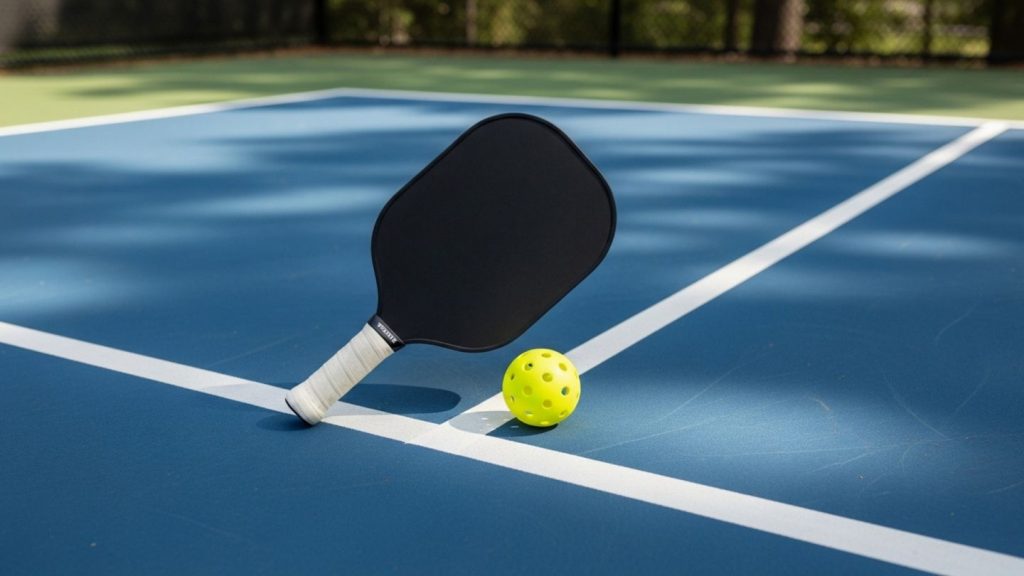
Several distinct elements characterize a pickleball court, ensuring both the appropriate conduct of the game and player safety. Key features such as the non-volley zone, service areas, and precise measurements for the net are integral to the proper configuration and operation of a pickleball court.
Grasping these crucial components is imperative when aiming to construct a court that adheres to recognized specifications while also improving the quality of play for participants.
Non-Volley Zone
In pickleball, the area referred to as the kitchen or non-volley zone is a vital part of the game. This zone spans 7 feet from each side of the net and exists to discourage players from performing volleys near the net. Enforcing this regulation not only fosters strategic gameplay but also diminishes potential injuries resulting from forceful plays.
Maintaining this non-volley zone contributes significantly to an equilibrium between defensive and offensive tactics within the game, enhancing both its difficulty and thrill for participants.
Service Areas
On a pickleball court, the service areas are segmented into two sections, one on the left and one on the right, with dimensions of 10 feet in width and 15 feet in length. These divisions play a pivotal role during serves since players need to send the ball diagonally across to land within their opponent’s corresponding service area.
Ensuring that these service areas are clearly delineated is essential for upholding fair play standards as it helps ensure accurate serving throughout gameplay, thus preserving the game’s integrity and ensuring consistent conduct during play.
Net Specifications
A net for a pickleball court is secured at the elevated point of 36 inches on the sidelines while dipping slightly to 34 inches in the middle. This minor variation ensures that the net remains stretched and with proper tension, which is essential for ideal play conditions. Adhering to these particular height specifications when setting up a net is vital for ensuring equitable gameplay and improving player experience.
It’s advised to use a dedicated pickleball net since it conforms more accurately to these specified height and tension standards compared to one designed for badminton.
Surface Materials for Pickleball Courts
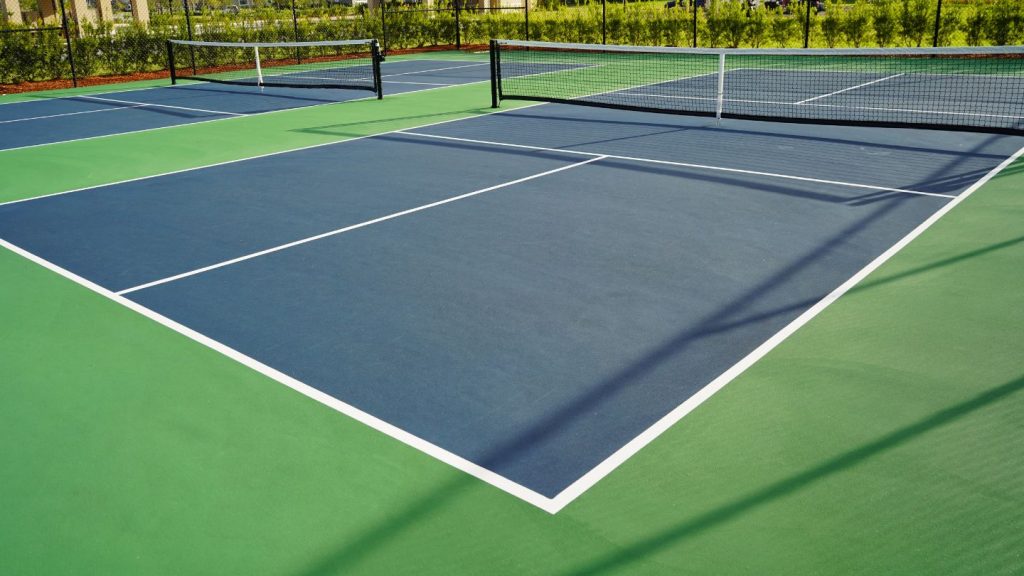
Selecting an appropriate surface material for a pickleball court is crucial to guarantee its durability and provide the best conditions for play. Acrylic surfaces are often favored because they offer superior performance and long-term usability. The chosen material can greatly influence how fast the game moves as well as the enjoyment levels of those playing.
To ensure that the pickleball court remains in excellent condition, consistent maintenance is necessary. This includes checking for any cracks or issues with the surface integrity. Safeguarding this investment every 2 to 5 years with a seal coat application will shield it from water damage and harmful UV rays while also preserving its appearance and texture.
Concrete Surfaces
Pickleball courts often favor concrete for the playing surface because of its robust nature and uniformity, which offers a dependable foundation for play. Applying paint to this type of surface can improve players’ footing by increasing traction.
It’s crucial to take into account both the quality of the paint used and varying weather conditions to maintain the durability of these surfaces. To preserve pickleball courts made from concrete in top shape, routine care, and periodic resurfacing are essential tasks.
Asphalt Surfaces
Pickleball courts made of asphalt surfaces are recognized for their affordability and reduced maintenance needs, making them a preferred option over alternative materials. This cost-effective solution is suitable for pickleball courts in both private homes and public community spaces.
The minimal upkeep requirements of asphalt contribute to its reputation as an easy-to-maintain surface, leading to fewer necessary repairs and lower ongoing costs. The use of asphalt presents a prudent choice when building pickleball courts due to its balance between initial investment savings and diminished long-term expenses.
Alternative Surfaces
Alternative surfaces, such as synthetic grass, can improve playability and comfort on pickleball courts, offering a distinctive playing experience when compared to standard hard court options. These surfaces can be fitted across different settings and provide an alternative feel during gameplay.
Although the installation of these types of surfaces might necessitate additional heat, and they come with their own set of maintenance guidelines, they present certain advantages that conventional concrete or asphalt pickleball courts do not offer.
Lighting and Fencing Considerations
Ensuring player visibility and safety on a pickleball court is essential, which necessitates appropriate lighting and fencing. With proper lighting, the opportunity to play can extend into the evening hours. Meanwhile, suitable fencing helps in keeping the ball within the court’s boundaries and enhances security.
There are multiple choices for fencing materials, such as vinyl and wood, that present distinct looks and resilience levels to suit various requirements and tastes.
Optimal Lighting Setup
It is strongly advised to utilize LED lights for pickleball courts, whether they are located indoors or outdoors, because of their reduced glare and energy-saving qualities. Having appropriate lighting is crucial for maintaining visibility during evening games, which helps decrease the likelihood of mishaps and improves the enjoyment of playing.
Implementing low-glare lighting solutions like fluorescent or LED can significantly diminish the reflection of the court’s surface. This ensures that players maintain clear vision of the ball even when there’s insufficient natural light.
Fencing Options
On a pickleball court, fencing fulfills various roles, including the retention of the ball within play and enhancing security. Commonly utilized materials for this purpose are wire mesh and chain link because they efficiently prevent the ball from going out of bounds while also ensuring that spectators can clearly see through to observe gameplay. Specifically, chain link fences are favored as they provide an unobstructed view of the court while maintaining control over the ball’s movement.
The decision regarding which kind of fencing to install should be guided by particular requirements unique to each court, along with any environmental factors that may influence this choice.
Adapting Existing Courts for Pickleball
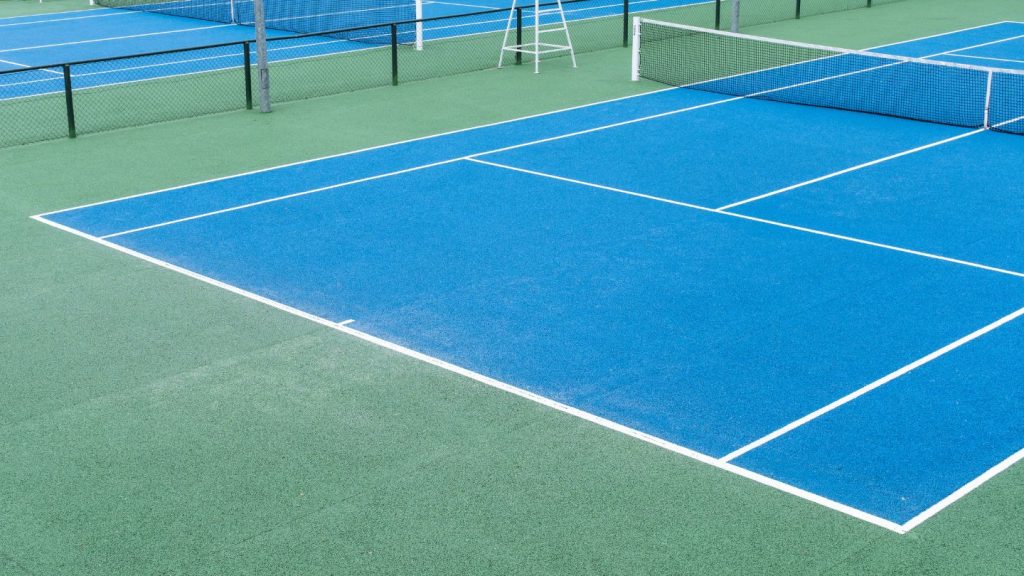
Transforming existing surfaces such as tennis or badminton courts into a pickleball court can serve as an economical alternative for aficionados wishing to engage in the sport. This method eliminates the need for erecting an entirely new court, thereby substantially diminishing the financial burden.
This strategy expedites and simplifies the creation of a USA pickleball-approved playing area while providing substantial savings on time and expenditure.
Tennis Court Conversions
Transforming a tennis court into one suited for pickleball requires multiple steps. To align with pickleball standards, the height of the net at its center should be adjusted to 34 inches. For rapid establishment and dismantling, temporary lines may be delineated using either tape or chalk.
Provided that the corners are not angled on a regular tennis court, it has enough space to house as many as four pickleball courts simultaneously. This adaptability allows for several games to take place concurrently.
Badminton Court Conversions
To adapt a badminton court for pickleball play, precise alterations must be made to align with the necessary dimensions. Given that the size of badminton courts exceeds those of pickleball, it’s essential to delineate the confines of a pickleball court appropriately. Employing tape or paint can achieve this and bring the playing surface up to regulation standards.
By making these changes, one can expediently transform a badminton court into an appropriate surface for pickleball games without requiring significant restructuring.
Tips for Building a Home Pickleball Court
Constructing a pickleball court at your residence is an exciting endeavor that necessitates meticulous planning and implementation. The expenses associated with creating a pickleball court can vary widely, ranging between $20,000 to $50,000. The total cost is influenced by several variables, including the site of construction as well as the materials and manpower required. One potential way to mitigate costs is by transforming existing courts into pickleball courts instead of starting from scratch.
Opting for a more budget-friendly material like asphalt may help in reducing expenditure while also accelerating the process of building your court. Selecting a flat location will not only streamline the setup but will also enhance how well your court plays when engaging in games of pickleball.
Planning and Measuring
Ensuring that the court conforms to regulatory standards and fits appropriately within the designated space requires precise measurements. Employ a measuring tape to meticulously gauge the court’s dimensions and configuration, taking into account any uneven surfaces or obstructions that might exist.
Careful measurement and preparation are crucial for preventing expensive errors and guaranteeing that the court is up to official specifications, thus offering an excellent experience for players.
Marking Court Lines
Defining the playing area in pickleball is achieved by marking court lines. For casual play, one can establish temporary lines utilizing tape or chalk, allowing for easy setup and flexible configurations that cater to both pickleball and various other sports without making lasting changes.
Ensuring accurate gameplay and aiding players in recognizing boundaries and service areas requires properly marked lines on the court.
Installing Accessories
Accessorizing your pickleball court can significantly improve its practicality and convenience. By incorporating structures that offer shade, you enable players to seek respite from the harsh rays of the sun, which increases the comfort and usability of the court in warmer conditions. Installing benches along the sidelines furnishes convenient spots for rest for those playing or waiting their turn, while storage options ensure that equipment is neatly stored and the court area remains clutter-free.
Products such as the Courtside Poly-Bench are crafted from robust materials like high-density polypropylene and PVC to furnish lasting seating solutions both for players taking a break during games and spectators enjoying watching them play.
Maintenance and Upkeep of Pickleball Courts
Ensuring that pickleball courts receive consistent maintenance and care is crucial for maintaining their condition and playability. Courts made of concrete are celebrated for their robustness, necessitating less routine upkeep than those constructed with asphalt. Nevertheless, it’s beneficial for both varieties of court surfaces to undergo regular cleaning and periodic resurfacing to preserve the best conditions for play.
By adhering to appropriate maintenance practices, the safety and enjoyment of the court can be sustained over time. This attentiveness also prolongs the life of the court while minimizing costs in the long run.
Regular Cleaning
Regularly sweeping the pickleball court on a daily basis is crucial for clearing away debris, which safeguards the acrylic coating from deterioration. A comprehensive cleaning with gentle detergent once a month is necessary to prevent moss and mildew accumulation that could lead to hazardous slippery spots. In case of spills, prompt spot cleaning should be undertaken to forestall enduring stains, ensuring that non-abrasive cleaning agents are employed so as not to damage the surface.
Consistent upkeep ensures both the safety and playability of the pickleball court by maintaining its cleanliness and removing any possible obstructions or dangers from the playing area.
Resurfacing Needs
To preserve the quality and playability of pickleball courts, it is crucial to resurface them regularly. Known for its robustness, concrete as a playing surface often demands less frequent maintenance than asphalt. Yet, both types of surfaces gain from routine resurfacing efforts that fix cracks and reinstate a level playing field.
Choosing suitable materials for the court’s surface boosts both its quality and durability. By resurfacing on schedule, one can safeguard the state of the court and guarantee an ideal experience for those engaging in pickleball.
Summary
Understanding the space requirements for building a pickleball court is essential to ensure optimal playability, safety, and functionality. From allowing enough room for gameplay to incorporating extra space for fences and surrounding areas, proper planning creates a comfortable and enjoyable environment for players of all levels.
At Talbot Tennis, we specialize in crafting high-quality pickleball courts that meet the unique needs of every client. As a trusted pickleball court contractor in Georgia, we bring precision, expertise, and dedication to every project. Whether you’re building a new court or upgrading an existing one, partner with us to create a space that supports exceptional play and stands the test of time. Let’s make your pickleball court vision a reality!
Frequently Asked Questions
What are the standard dimensions of a pickleball court?
A standard pickleball court measures 20 feet in width and 44 feet in length, with a recommended total area of 30 feet by 60 feet for safety. This ensures ample space for players to move comfortably during the game.
What materials are recommended for the surface of a pickleball court?
Acrylic surfaces are highly recommended for pickleball courts due to their durability and performance, while concrete and asphalt are also viable options, each providing unique benefits.
How can I convert an existing tennis court for pickleball?
You can convert a tennis court for pickleball by lowering the net to 34 inches at the center and marking the pickleball court lines using tape or chalk. This setup allows for the accommodation of up to four pickleball courts on a single tennis court.
What are the benefits of using LED lights for a pickleball court?
Installing LED lights on a pickleball court improves the playing experience by providing reduced glare, energy-saving benefits, and excellent visibility for games played at night. They are thus an optimal option for players and venues alike.
How often should a pickleball court be resurfaced?
Regular resurfacing of a pickleball court is essential to ensure the best playing conditions, with concrete courts demanding less maintenance compared to those made of asphalt. It’s important to perform resurfacing at appropriate intervals to preserve the quality and playability of the pickleball surface.